‘Maramania’: The Great Wildebeest Migration in Action
The Great Wildebeest Migration is one of those wildlife events that’s difficult to put into words until you’ve seen it for yourself. The scale is enormous, the noise is constant, and the energy around a river crossing is unlike anything else I’ve experienced in Africa.
I’ve been fortunate to witness the Great Migration many times over the years, and it never fails to impress. Each crossing feels different, shaped by the light, the numbers, the conditions, and the behaviour of the animals themselves.
Wildebeest Photography
Naturally, the migration also presents remarkable opportunities for wildlife photography. The sheer mass of animals on the move, the tension at the river’s edge, and that familiar moment of uncertainty — will they, or won’t they, make it across safely? — all combine to create scenes full of drama and unpredictability.
I continue to return to the Mara for the Great Migration and to host small-group photo safari tours to Africa each year because it allows photographers to experience this fascinating event first-hand.
Creatively, the photographic potential of the wildebeest migration feels endless. Each visit brings new challenges and new possibilities, and I’m always drawn to the task of creating fresh images that document this extraordinary natural event in an honest and considered way.
Related: The Great Migration in Africa: Witness Nature's Grandest Spectacle
The Making of Maramania: The Full Story of the Great Migration
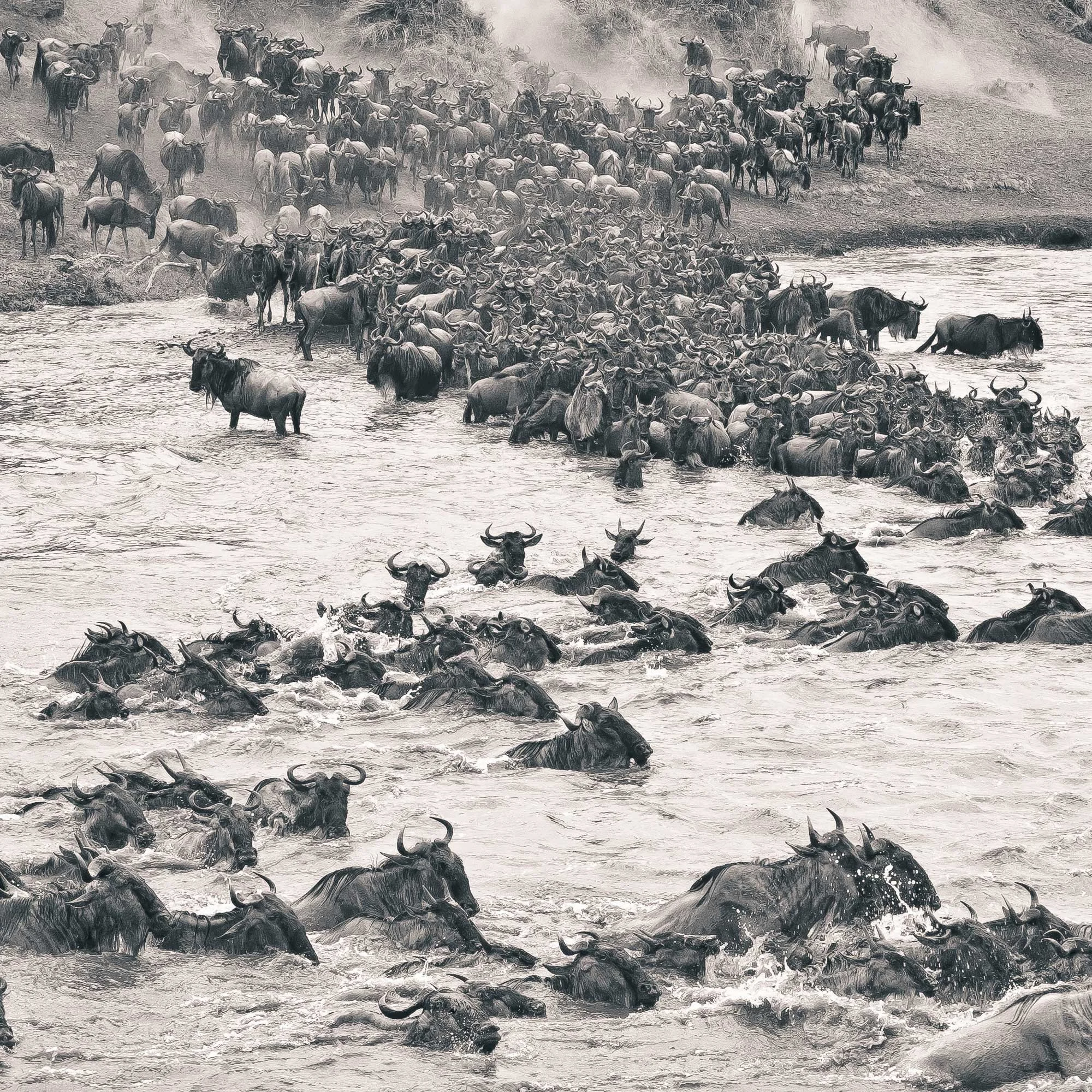
My photo print, Maramania, was captured during a wildebeest crossing of the Mara River in Kenya, back in 2010.
This particular crossing took place early in the migration season, and it went on for around two hours, with more than ten thousand wildebeest making their way across the river at a notoriously difficult point.
I was positioned low down on the riverbank, with animals exiting just a few feet away. A 70mm focal length was enough. There was no need to compress the scene. I wanted the picture to feel immersive and honest, as if you were standing right there.
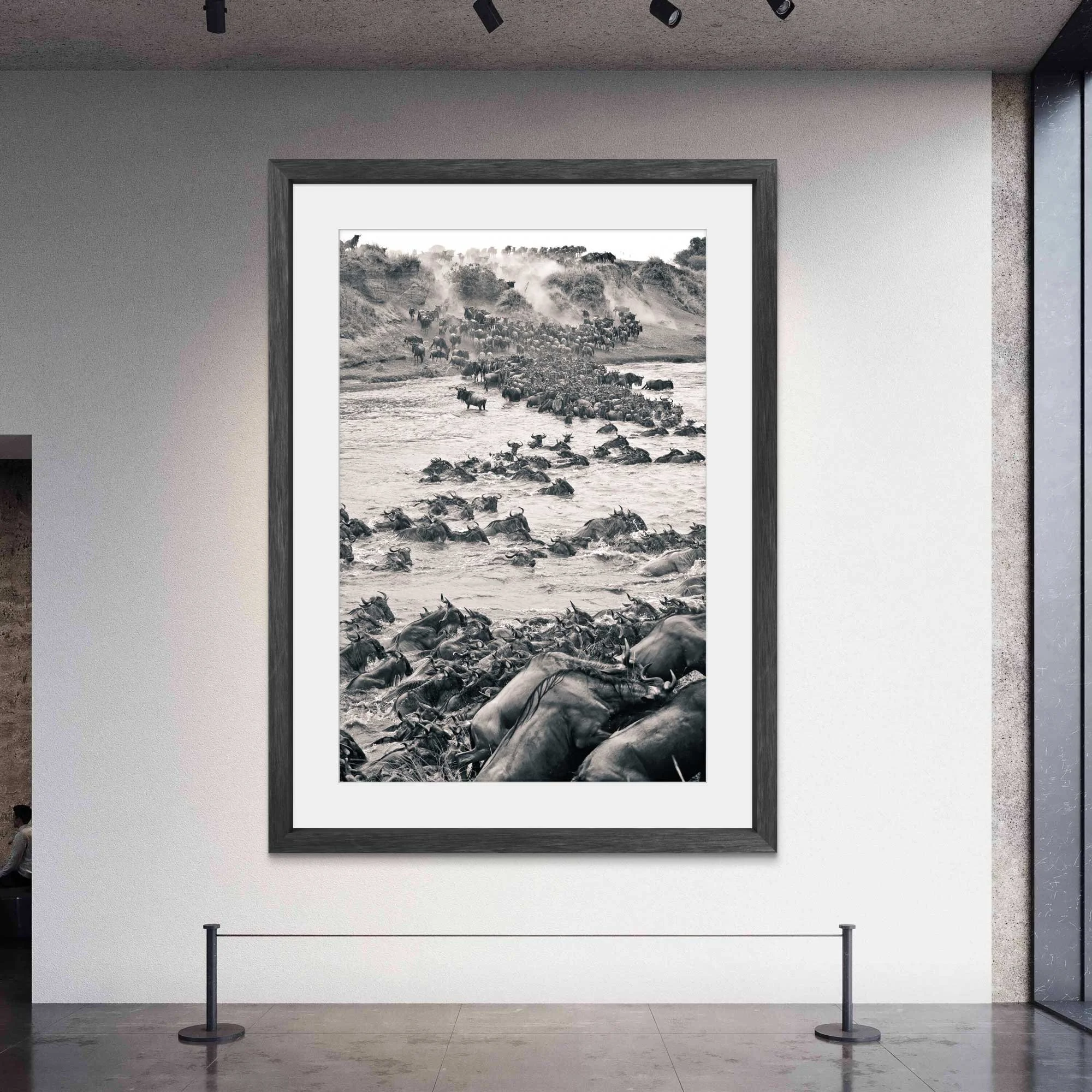
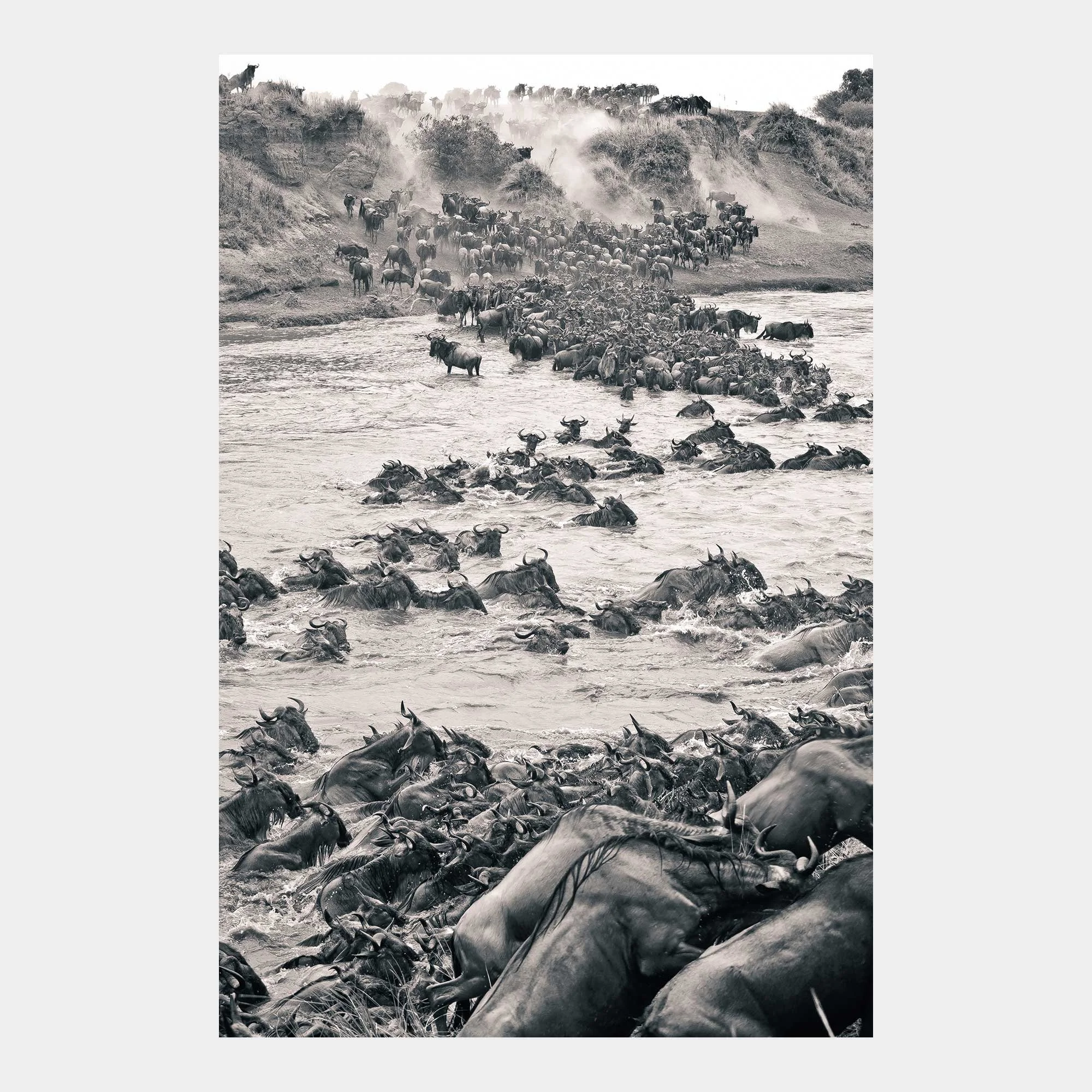
What drew me to this moment, and what I enjoy looking at in this image, is the fact that the full story of the wildebeest crossing is unfolding at once in this single frame.
In Maramania, you can see the animals’ uncertainty as they teeter at the water’s edge before entering the river, as well as their determination and struggle in the fast-moving current, and their frantic exit onto the bank in the foreground.
Related: How To Photograph a Wildebeest Crossing During Migration Season
Why Maramania Works as a Fine Art Print
Migration images lend themselves well to large-scale printing because there’s so much going on within the frame. The repetition of the animals creates rhythm, while the movement within the image gives it undeniable energy.
It’s my view that with Maramania, the longer you spend looking, the more you notice.
As well as the mass movement of animals, it tells the stories of individual animals as they embark on the crossing, which will determine whether they live another day or succumb to the water or prey lurking within.
It’s a wildlife picture that works so well on a wall because there is always something new to discover within it.
The Challenge of Photographing the Great Migration in Africa
Wild animal river crossings are intense, but they’re also unpredictable. During the wildebeest Great Migration, sometimes you wait for hours, and nothing happens. Other times, it all kicks off without warning.
For photographers on safari in Kenya, Mara River crossings present almost too many choices. There’s action everywhere. Animals are arriving and leaving the river and animals are mid-crossing. As a photographer, you have to decide quickly where to focus. It’s overwhelming at times, but that’s part of what makes it so engaging.
It’s certainly true that no two river crossings are ever the same. Every year, the story plays out slightly differently.
Even at the same spot on the river, the light, the numbers, the behaviour and the outcome change constantly. That’s why the Great Migration never feels repetitive, no matter how many times you see it.
My Favourite Wildebeest Migration Art Print, Maramania
Maramania is a reminder of just how raw and unscripted the natural world can be, and is a personal favourite. As a fine art print, it is available in an edition of 75 in all sizes. View it within my online store for more information, specification details and pricing.
Please note that the curated print collections are regularly revised and updated, and many prints are available only for a limited time. Keep checking the store for new additions.
Join me on a Great Migration Safari in the Maasai Mara
I host small-group photo safaris to the Mara during the migration season, with the focus firmly on respect for the animals and quiet observation.
During our photo safaris, we don’t rush between sightings. We wait, watch, and let things unfold naturally. This is how we achieve the best possible images of wildlife in the Maasai Mara.
Being present for a wildebeest crossing is something that stays with you forever. If you’d like to experience what’s known as the greatest wildlife spectacle on earth, then explore the opportunities to join me on a Great Migration photo safari this year.
And, if you enjoyed this, please subscribe to receive wildlife photography tips, news and advance notice about print releases, safaris, new destinations and subscriber offers.
David
Related: The ultimate guide to fine art wildlife prints by David Lloyd
Wildebeest Migration Facts & Information
What is the Great Migration?
The Great Migration in Africa is one of the most spectacular events in the natural world, sometimes referred to as the greatest show on earth. It is the movement of over 2 million animals migrating from the Maasai Mara into the Serengeti in Tanzania.
What animals can you expect to see during the Great Migration?
The migration involves around 1.5 million wildebeest, 400,000 zebra and 200,000 gazelles.
On a photo safari during the migration, you can also expect to see giraffe, antelope, hippos, elephants, and of course, the Maasai Mara’s famous big cats, including lions and cheetahs.
Where is the best place to witness the Maasai Mara migration?
The Maasai Mara in Kenya is one of the best places in Africa to experience the Great Migration.
When is the best time to witness the Maasai Mara wildebeest migration?
The migration happens between July and October.During August and September, the density of wildlife is extraordinary, and the river crossings are often at their most active.


