How To Photograph a Wildebeest River Crossing During Migration Season

The Great Migration in Kenya’s Maasai Mara is one of the most intense wildlife spectacles on earth. But photographing a wildebeest crossing during migration season, especially at close quarters, is very different from simply witnessing it.
It requires anticipation, patience, restraint, and occasionally, quick decisions under pressure.
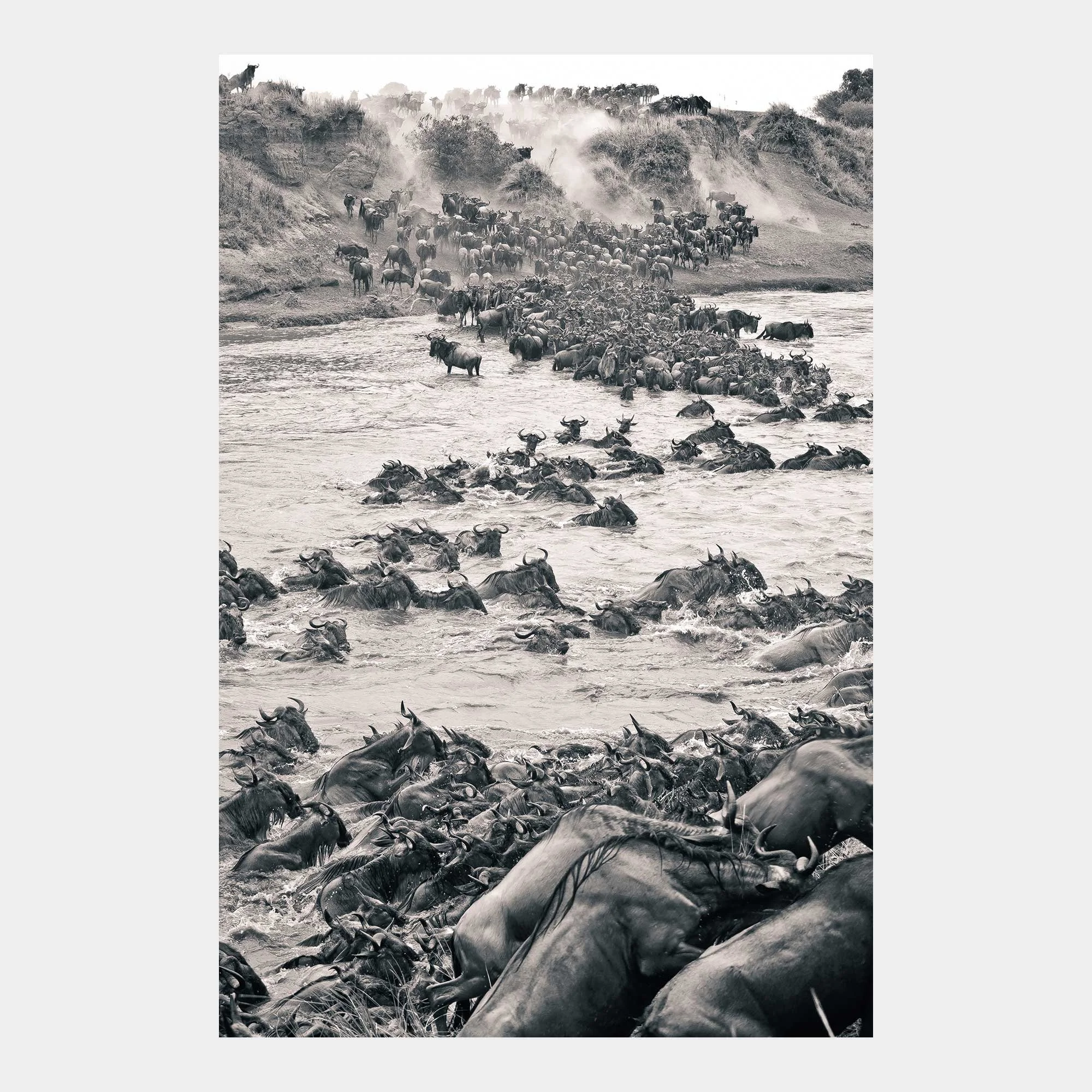
In this article, I’m sharing my experience of photographing one such wildebeest crossing, during the Maasai Mara migration season, which led to me capturing the image that later became known as Maramania.
Maasai Mara Migration Photography Tips
As a wildlife photographer, to photograph a wildebeest river crossing in the Maasai Mara, you’ll need to be prepared to wait for the wildebeest herd to begin to cross before approaching the river.
A wildebeest crossing is not predictable. The herd gathers, waits near the river, moves forward, stops, and then retreats. Tension builds for hours, sometimes days, and then, suddenly, without warning, it happens.
Once they’ve begun to cross the river and are in full flow, you’ll need to go quickly with your camera gear to get a good spot.
Be aware that you don’t want to make too much noise in case you scare the animals and send them back. It’s my view that it’s incredibly important to observe wildlife behaviour, and not to disrupt it.
A Migration River Crossing Photo (that almost never was)
On the day in September 2010 that I captured the image, now known as Maramania (shown above), I was witnessing my second river crossing during migration season.
Even though this was some time ago now, by then, I’d already seen enough to realise I wanted a wildebeest river crossing picture of the type I’d seen others achieve: a wide view up the river with the wildebeest coming down off the bank on one side, then up the other side and everything in between.
With a wide-angle zoom and a 70-200mm lens at my disposal, the wide-angle picture I wanted looked very possible. I just needed:
· the river
· a lot of wildebeest
· a viewpoint
· and, a wide-angle lens.
However, it was maybe 150 metres to the river, and by the time we got there, I’d realised I’d left the wide-angle behind!
From those four necessary things I needed for this picture to be, I was only in possession of one important component before I began. And it was my fault completely.
So, what to do now? Where a 24mm lens would have likely made the picture I wanted, all that was available to me at the time was 70mm as my widest option, so, so far away from 24mm.
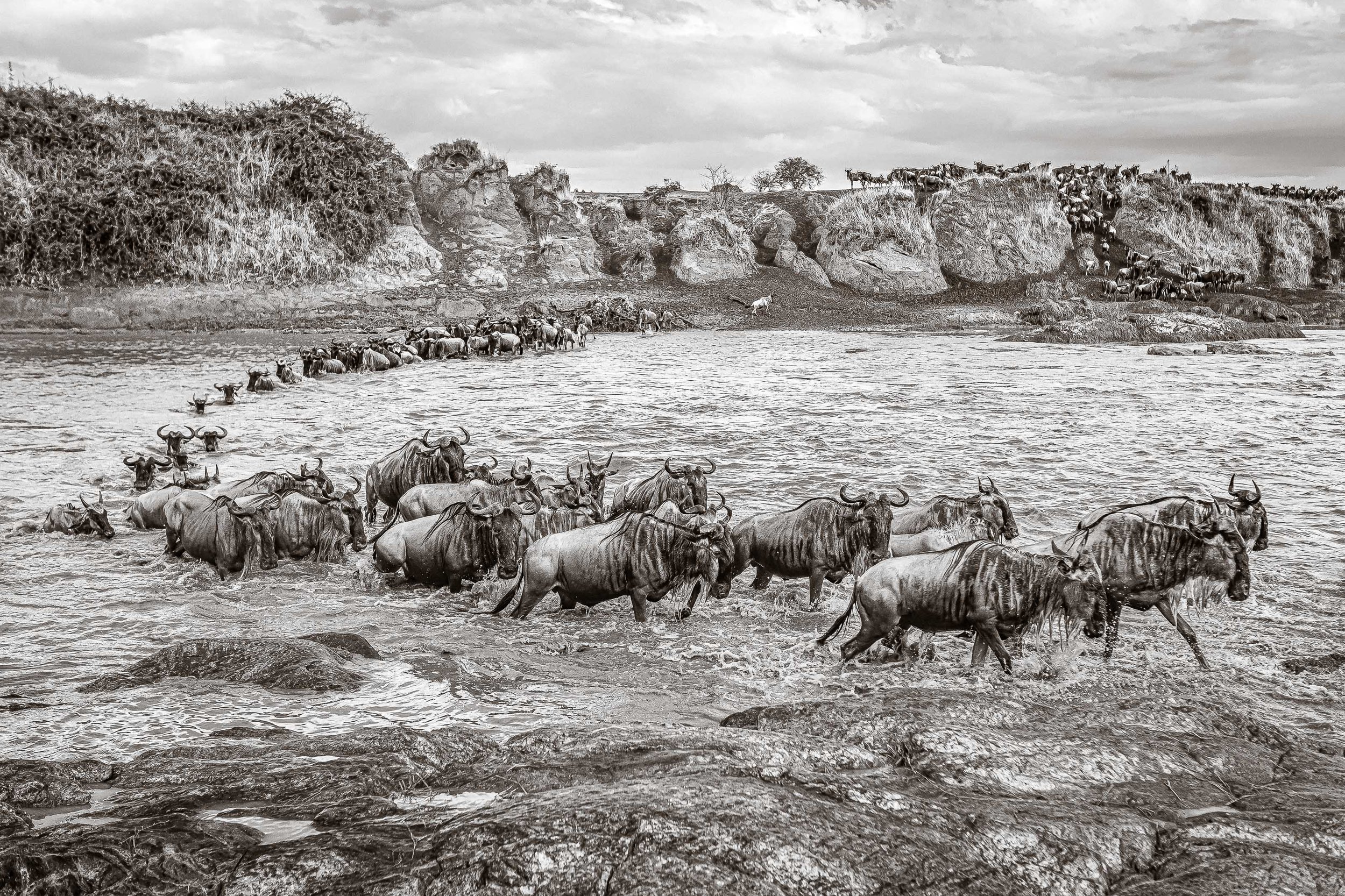
With the long zoom, I was able to get some pretty good pictures, but mostly of groups of struggling wildebeest; I got a few good ones of them in the river trying to exit. But I was still haunted by the fact that I’d left the wide lens behind, and the scene I wanted it for was happening right before me.
Adapting My Wildebeest Migration Photography Plan
It was inescapable. I soon figured that if I crept back a little bit and put the camera into vertical orientation, I could get both the far bank and near bank in frame.
As well as the animals popping into the water in the far side, they were now exiting pretty much in front of me as well. So the idea of catching them entering as well as exiting was being realised at 70mm. And all that I wanted to happen in between those points was there too.
The only thing that remained to do, was to ensure both far and near were in as much focus as possible. f/9.5 pretty much achieved it, although in hindsight, maybe f/11 may have been better.
Afterwards, the pictures, as seen on the back of the camera looked pretty good, but the muddy brown of the water did not appeal to me. I think this may be why we see so many such pictures rendered in black and white (and, of course, black and white restores some drama to the scene too).
The processing of this wildebeest river crossing image took a long time before I was happy with it. I think I sat on this one, editing intermittently, for maybe six months.
Initially, I did not feel I was capturing the scene as I recalled it. But when I added the spilt toning, I decided that it was done. It is probably the most satisfying Maasai Mara river crossing picture I have taken and I have not bettered it yet.
And it likely would not have been if I’d had my wide lens with me. But that mistake led to a little discovery, then a little creativity, all in turn, making the picture.
Lessons from Photographing a Wildebeest River Crossing
Looking back, there are a few key lessons I took from that day in the Maasai Mara:
1. Preparation Matters, but Flexibility Matters More
You can plan for a crossing. You can anticipate movement. You can choose your lenses carefully. But when thousands of animals decide to move, you adapt quickly or you miss it. The migration does not wait for you.
Good wildlife photography need not be all about careful planning all of the time; it can also be the result of happy accidents.
2. Composition Is Everything
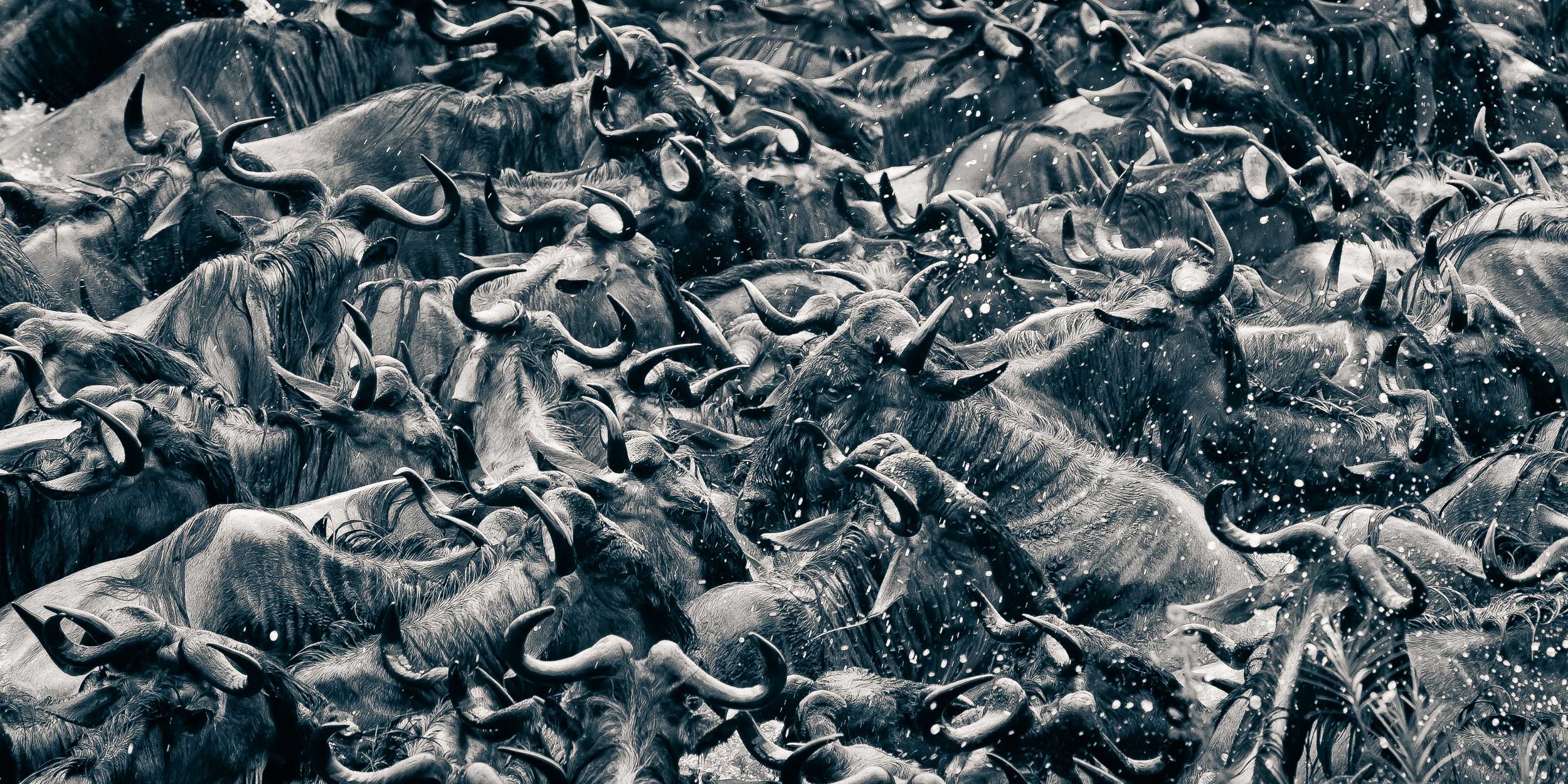
In a wildebeest crossing, chaos is everywhere — splashing water, dust, movement, panic, tension. The challenge is not capturing action. The challenge is organising it within the frame.
Finding both entry and exit points within a single image was what gave Maramania its structure.
3. Black and White Can Restore Drama
River water in the Maasai Mara is rarely appealing in colour. It’s muddy, brown and flat.
In black and white, however, texture replaces colour. Contrast replaces distraction. The eye travels through the frame differently. It gives the image weight.
Photographing the Great Migration Today
The Great Migration remains one of the most compelling wildlife photography experiences in Africa. Around 1.5 million wildebeest, accompanied by zebra and gazelles, move in a continuous loop through the Serengeti and Maasai Mara ecosystems.
River crossings are unpredictable. Some days there are none. Some days there are multiple. Sometimes thousands cross in minutes. Sometimes they hesitate for hours. That uncertainty is part of what makes photographing the migration so addictive.
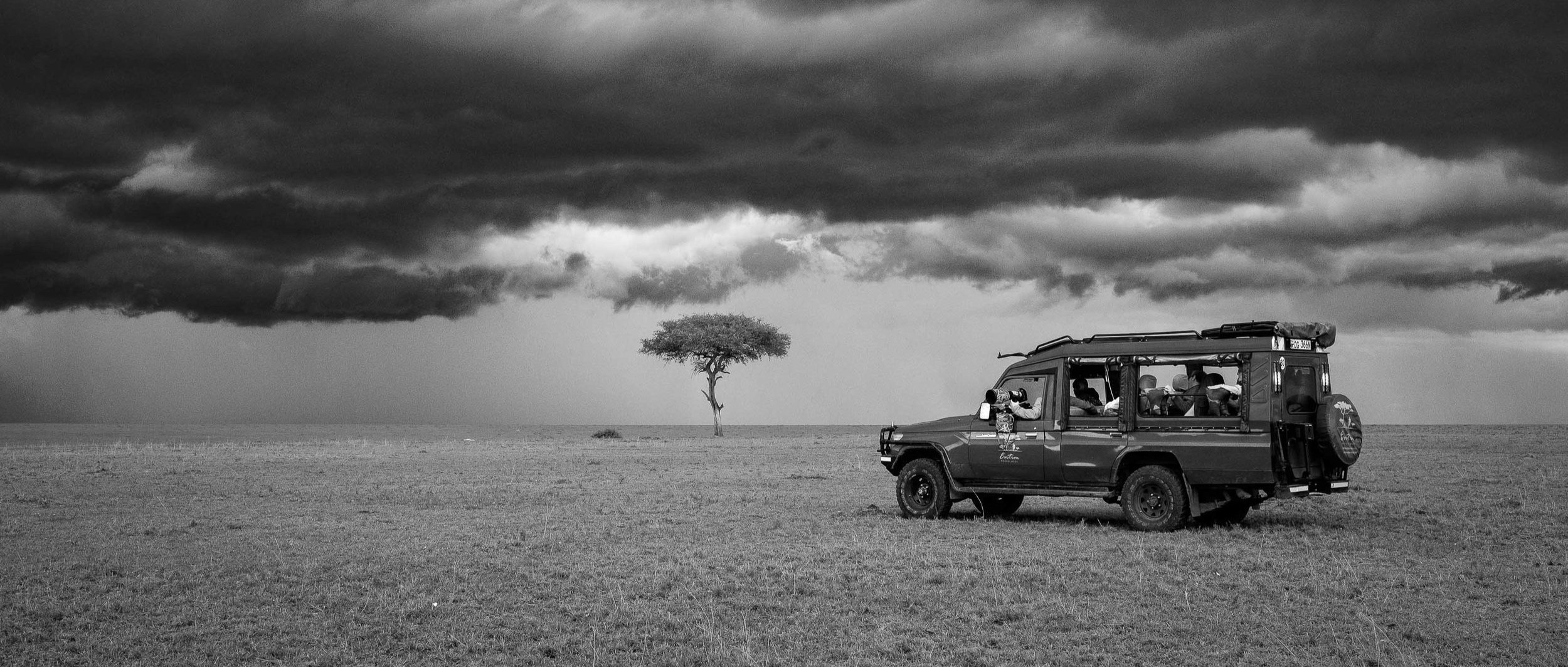
On my Great Migration photo safaris in the Maasai Mara, we position ourselves carefully, keep disturbance to a minimum, and wait. There are no guarantees, but when it happens, you are ready.
Maramania – A Migration Fine Art Print
Maramania captures a full crossing — entry, struggle, and exit — in one frame. It remains one of my most satisfying images from the migration.
The print is available in my online store as a fine art wildlife print.
For those who have experienced a crossing, it brings back the noise, the tension, and the scale of the scene that unfolded in front of my eyes that day. For those who haven’t yet witnessed the migration for themselves, it is a reminder of what is possible.
If you would like to experience the Great Wildebeest Migration in the Maasai Mara yourself, discover my Great Migration photo safaris. Alternatively, find out more about Maramania – a fine art print you can add to your wall art collection.
If you enjoyed this, please subscribe to receive wildlife photography tips, news and advance notice about print releases, safaris, new destinations and subscriber offers.
David
Related: The ultimate guide to fine art wildlife prints by David Lloyd


